
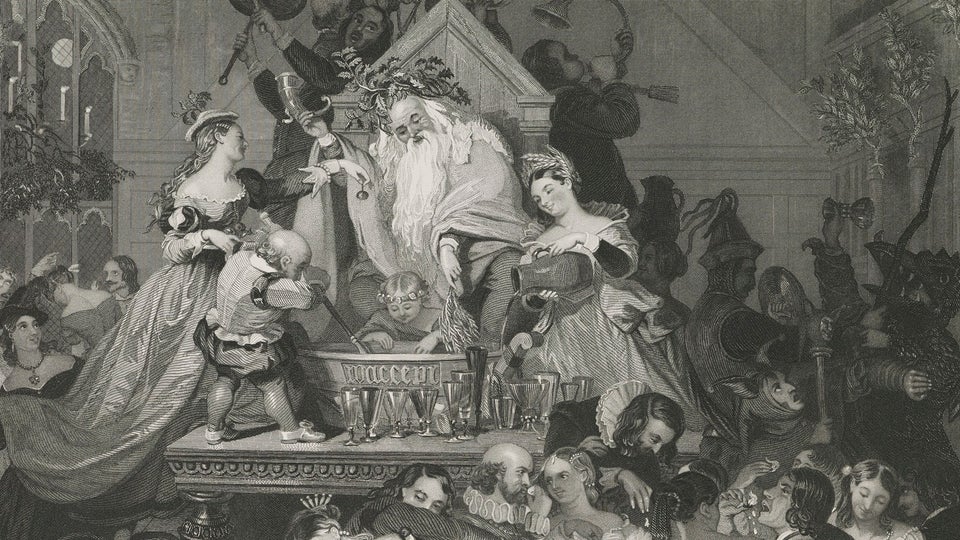
‘Christmas. The Wassail Bowl’ by Thomas Hollis after R.W. Buss. The wassail bowl is the centrepiece of this 1851 engraving of merriment and revelry
Epiphany begins tonight at sunset, as the 12 day of Christmas ends. So, what better way to ring in Epiphany than with the Robert Herrick poem, the 12th Night. The sun has just set, so lets get the cake ready…
The following pen was written by Robert Herrick, a clergyman of the Church of England. After England’s civil war, Herrick was displaced or rather kicked out of his living quarters because the worship of the Church of England; and the customs of the country-side, including the celebration of Twelfth Night had been abolished because of the Civil War. Any celebrations therein, were made criminal. Inasmuch, because shops were not allowed to open, riots ensued, referred to as The Plum Pudding riots.
Herrick lived until 1674. He was restored to his ministry in 1660. Knowing, the return of King Charles II and things would be restored, he penned the celebratory poem, Twelfth Night.
TWELFTH NIGHT : OR, KING AND QUEEN.
by Robert Herrick NOW, now the mirth comes With the cake full of plums,
Where bean’s the king of the sport here ;
Beside we must know,
The pea also
Must revel, as queen, in the court here. Begin then to choose, This night as ye use,
Who shall for the present delight here,
Be a king by the lot,
And who shall not
Be Twelfth-day queen for the night here. Which known, let us make Joy-sops with the cake ;
And let not a man then be seen here,
Who unurg’d will not drink
To the base from the brink
A health to the king and queen here. Next crown a bowl full With gentle lamb's wool :
Add sugar, nutmeg, and ginger,
With store of ale too ;
And thus ye must do
To make the wassail a swinger. Give then to the king And queen wassailing :
And though with ale ye be whet here,
Yet part from hence
As free from offence
As when ye innocent met here.
*Wassailing historically occurred on the twelfth and final night of Christmas. Wassailing is a Twelfth Night tradition that has been practiced in Britain for centuries. It has its roots in a pagan custom of visiting orchards to sing to the trees and spirits in the hope of ensuring a good harvest the following season.
(*Source: http://www.nationaltrust.org.uk/features/ritual-and-revelry-the-story)


 She said What? A Blog